
Designing the family journey: how schools build trust, belonging, and long-term growth
A family's experience of your school begins long before the first day of class. And it continues long after the last.
It starts with a Google search, a conversation with another parent, or a visit to your website. It grows through the admissions process, the first nervous morning at the school gate, everyday conversations with teachers, and the small moments that make families feel part of a community.
Every interaction leaves an impression. Some build confidence and connection. Others create confusion, frustration, or doubt.
The question is: are you intentionally designing these experiences, or simply letting them happen?
This was at the heart of Kinderpedia's recent webinar, Designing the Family Journey in Your School: How to Build Trust, Belonging, and Long-Term Growth, featuring Dr. David Willows and Suzette Parlevliet, co-founders of Yellow Car, alongside Evelina Necula, CMO and Co-founder of Kinderpedia.
Together, they explored how schools can move beyond reactive communication and create a more thoughtful, connected experience for every family.
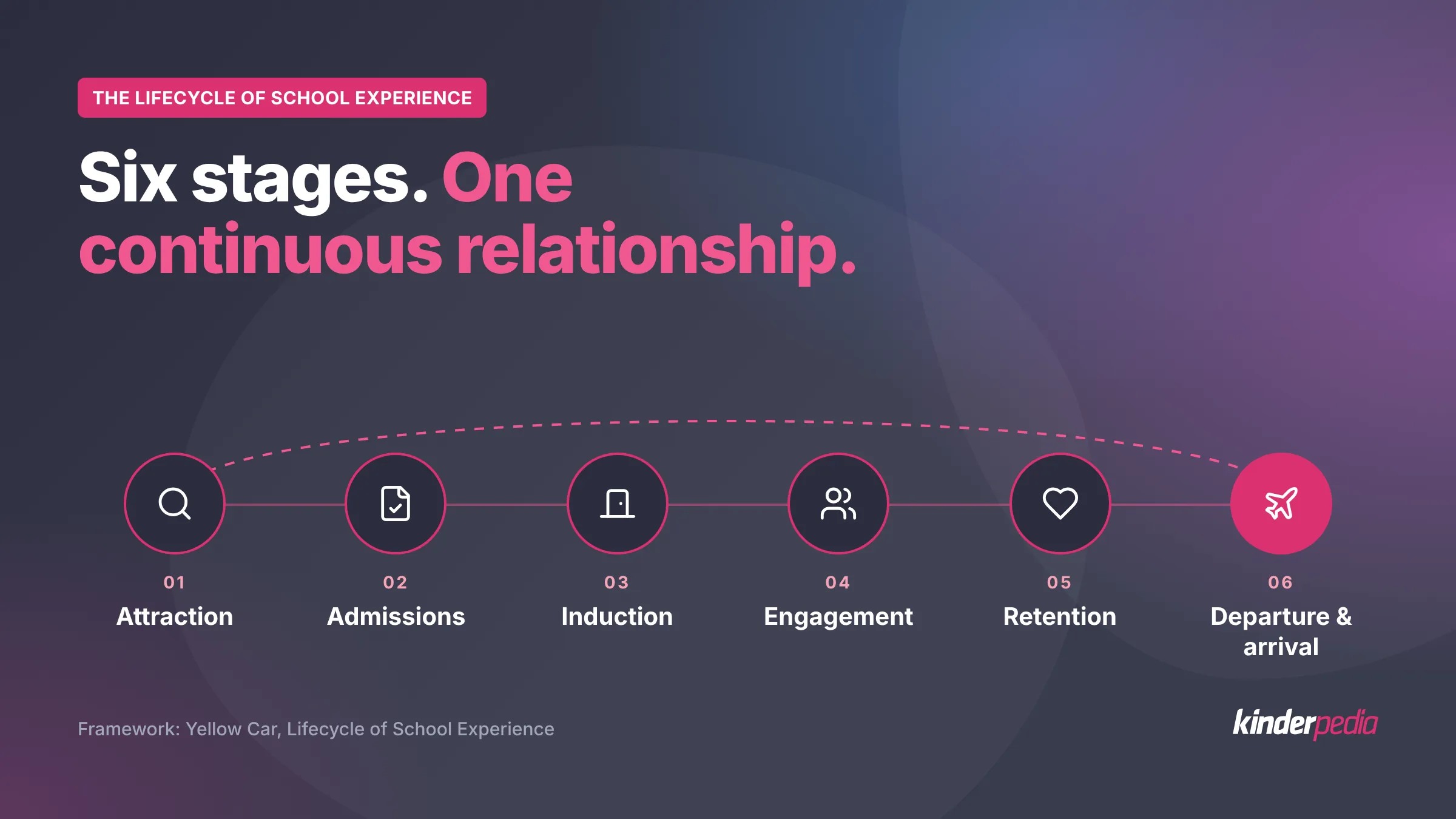
In short: the school family journey is the complete experience a family has with a school, from the first search to the final farewell. Yellow Car describes it in six stages (attraction, admissions, induction, engagement, retention, and departure and arrival). Schools that design each stage intentionally, reduce everyday friction, and communicate clearly build the trust that drives enrolment, retention, and word-of-mouth growth.
Why the family experience matters more than ever
Schools are finding it increasingly difficult to stand out.
Visit a handful of school websites, and you'll probably find similar promises: excellent teachers, inspiring learning environments, outstanding opportunities, and a commitment to every child's success.
These are important qualities. But when every school makes similar promises, how can parents tell the difference?
David Willows and Suzette Parlevliet believe the answer lies in the experience itself.
Parents aren't simply choosing a curriculum, a campus, or a set of exam results. They're choosing a place where their child will spend a significant part of their childhood.
They want to know whether their child will feel safe, understood, encouraged, and happy. They want to feel confident that the school will communicate openly and stand beside them when challenges arise.
And those expectations cannot be met through marketing alone.
A school's reputation is built through the everyday experiences that families have, remember, and share with others.
The six stages of the school family journey
One of the central ideas shared during the webinar was Yellow Car's Lifecycle of School Experience.
Rather than treating admissions, communication, engagement, and retention as separate responsibilities, this framework invites schools to see the entire relationship through the eyes of a family.
The journey has six stages: attraction, admissions, induction, engagement, retention, and departure and arrival.
1. Attraction: Your school's story begins before the first enquiry
Before contacting your admissions team, families are already forming opinions about your school.
They may explore your website, read reviews, ask friends for recommendations, or compare schools using AI-powered search tools.
But what makes your school memorable?
According to Suzette Parlevliet, the challenge is moving beyond generic educational promises and communicating what the experience of being part of your school actually feels like.
Show families what makes your community distinctive. Share authentic classroom experiences, student achievements, meaningful traditions, and the everyday moments that reflect your values.
As Evelina Necula highlighted during the webinar, some of the most powerful stories about a school are told by its own families.
A parent sharing a classroom photo or an exciting learning experience with friends can communicate something that even the most polished marketing campaign struggles to capture: genuine enthusiasm.
2. Admissions: Make families feel heard, not processed
The admissions process is often a family's first direct experience of how a school operates.
Are enquiries answered promptly? Are the next steps clear? Does the school listen before presenting its programmes?
At their former school in Brussels, David and Suzette helped create an experience room for prospective families.
Instead of starting with a traditional presentation, families were invited into an interactive conversation about what mattered most to them when choosing a school.
This helped the admissions team understand their priorities and adapt the school tour accordingly.
At the end of the visit, families were invited to leave their impressions on a wall of notes, in their own language or through drawings.
A simple gesture became a memorable experience and a visible collection of authentic first impressions.
The lesson for admissions teams is simple: a great school visit isn't about showing everything your school offers. It's about understanding what matters to the family standing in front of you.
Technology can support this process by helping schools organise enquiries, track conversations, manage applications, and carry important family information forward into the student's school record. That's exactly what an admissions CRM for schools is designed to do, giving admissions managers a clear view of every family, from first enquiry to enrolment.
But the human connection remains essential.
3. Induction: Turn the first 30 days into a sense of belonging
Joining a new school is exciting, but it can also feel overwhelming.
Parents have forms to complete, schedules to understand, people to meet, and countless practical questions. Children are adjusting to new teachers, classmates, routines, and expectations.
This is where thoughtful onboarding makes a difference.
Suzette shared an example from her experience in Brussels. Rather than overwhelming new families with handbooks, emails, PDFs, and links, the team created a small pocket guide containing the eight things every parent needed to know before the first day.
It didn't replace detailed information. It simply gave parents a clear place to start.
Schools can apply the same principle through welcome messages, short teacher introduction videos, classroom previews, clear schedules, and practical first-week guidance.
Kinderpedia supports these moments through its newsfeed, direct messages, shared information, and classroom updates in the parent-teacher communication app, helping schools communicate consistently before and after the first day.
The goal isn't to send more information.
It's to help every family arrive feeling prepared, expected, and welcome.
4. Engagement: Help families become part of the school community
Once the first few weeks have passed, the challenge shifts from welcoming families to maintaining a meaningful connection.
Parents want to understand what their children are learning, celebrate their progress, and feel involved in school life.
But engagement is more than sending announcements.
It's about creating opportunities for families to contribute, ask questions, share feedback, and build relationships with teachers and other parents.
This can happen through school events, surveys, classroom updates, parent conversations, or small community initiatives.
Digital communication can make these interactions easier. Kinderpedia brings together messages, newsfeed updates, event invitations, polls, and learning information in one place, helping families stay connected without navigating multiple disconnected channels.
For international schools, multilingual communication can also make a significant difference. When parents can access information in a language they understand, it's easier for them to participate confidently.
As Evelina emphasised, families should not be mere passengers in the school journey.
They should have opportunities to shape the community they belong to.
5. Retention: Trust grows through everyday consistency
Why do families stay at a school?
A strong academic programme matters. So do relationships, expectations, and the feeling that their child is progressing.
But trust also depends on something much simpler: whether the school consistently delivers on its promises.
Parents shouldn't have to wait for a problem to learn how their child is doing. They shouldn't struggle to understand a school invoice, search through dozens of emails for an important announcement, or wonder who to contact when something goes wrong.
During the webinar, David recalled speaking with a parent of four children who was receiving around 36 school emails every day.
Instead of feeling informed, she felt overwhelmed.
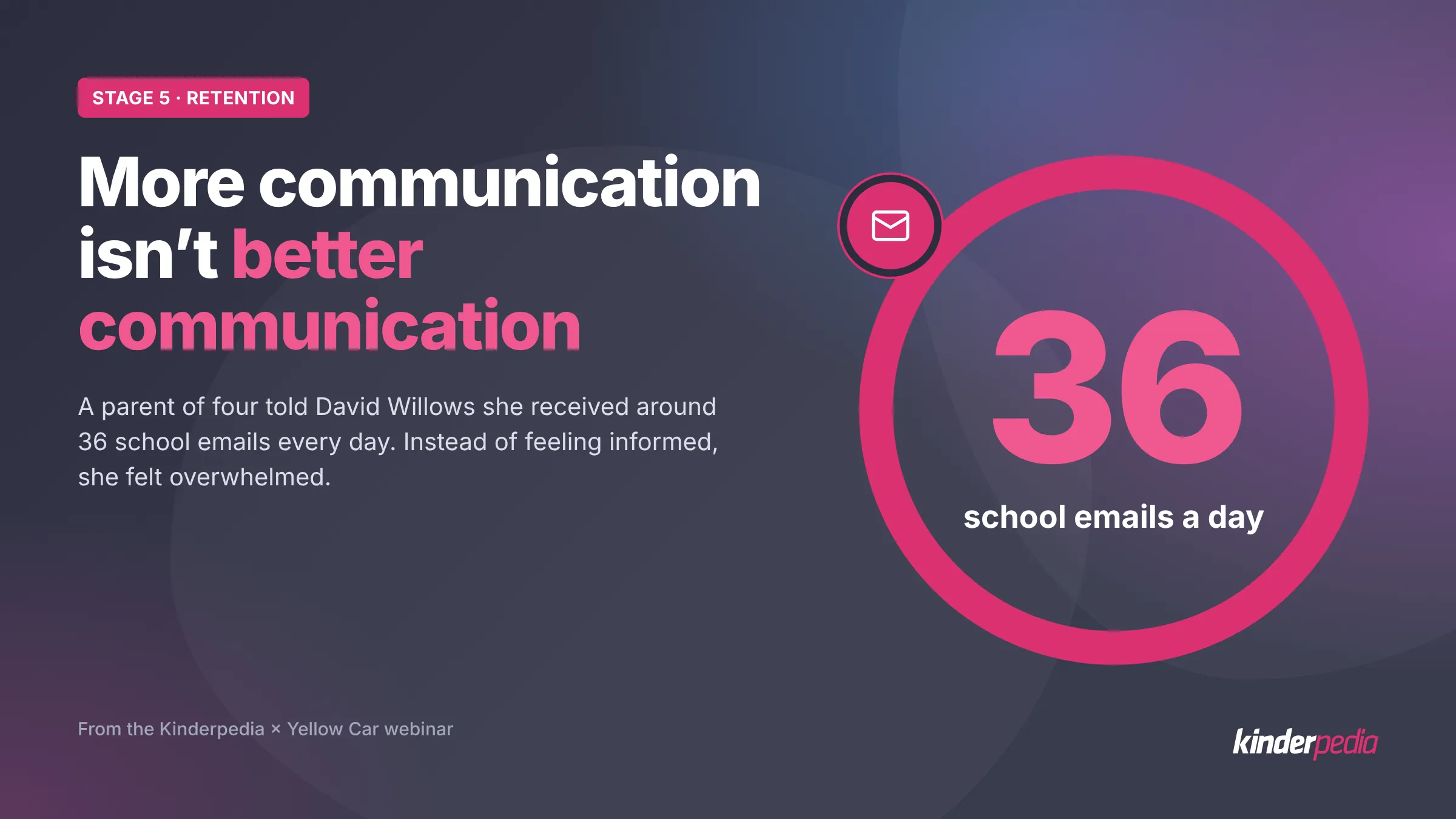
This illustrates an important distinction: more communication doesn't necessarily create a better experience. Clearer communication does.
Regular progress updates, transparent billing, accessible school information, and structured incident reporting all help reduce uncertainty.
With Kinderpedia, schools can connect these everyday processes, making academic progress, communication, and administrative information more accessible to families.
Retention is also shaped by how schools manage transitions between educational stages.
When a child moves from kindergarten to primary school, or from one school cycle to another, families need confidence that the school understands their child's development and will support the next step.
A well-maintained student portfolio and continuity of information between teachers can make these transitions more reassuring.
Retention doesn't begin when a family considers leaving.
It begins with the trust built throughout every school day.
6. Departure and arrival: Make the goodbye matter
Not every family will stay forever.
Students graduate. Families relocate. Children move on to new schools and opportunities.
But the way a school says goodbye can shape how people remember their entire experience.
During the webinar, Suzette shared an example from a school that created personalised farewell puzzles showing the connection between the school and a departing family's home.
The gesture recognised the relationship they had built and gave them something meaningful to take into their next chapter.
Schools can create similar moments through personalised farewell messages, graduation celebrations, shared memories, or thoughtful alumni communication.
Even after leaving, families can remain advocates for the school.
A meaningful departure celebrates what came before and keeps the connection alive.
The little moments families remember
Not every improvement to the school experience requires a large budget or a major new initiative.
Sometimes, the smallest gestures leave the strongest impressions.
David illustrated this through the famous popsicle hotline at a Los Angeles hotel, an example also featured in Chip and Dan Heath's book The Power of Moments.
Guests could pick up a telephone by the swimming pool and request a complimentary popsicle, delivered on a silver tray.
The gesture was simple, unexpected, and memorable.
What might a school's equivalent of that moment look like?
During the webinar, the Yellow Car team shared several examples from schools around the world.
At Oaks Christian School in Los Angeles, school leaders visited new students at home before the beginning of the school year, delivering welcome gifts and creating a personal connection.
At Singapore American School, a baseball and softball tournament became a community experience when students and athletes exchanged custom trading cards.
In Bucharest, a school transformed traditional opening-day ceremonies and staff development activities into more symbolic, memorable experiences.
These initiatives were different in scale, but they shared one quality: they were designed around how people would feel.
Schools don't need to copy them. They need to identify the moments that matter to their own communities.
A handwritten welcome note, a teacher remembering a child's favourite activity, or a thoughtful follow-up after a difficult conversation can have just as much meaning.
The most memorable experiences are often the ones that make people feel genuinely seen.
Reduce friction before creating more memorable moments
Creating extraordinary moments is valuable. But schools also need to pay attention to the ordinary ones.
An inspiring open day cannot compensate for weeks of unanswered emails. A wonderful school celebration means less when parents constantly struggle to find important information.
David and Suzette suggested three questions to guide experience design.
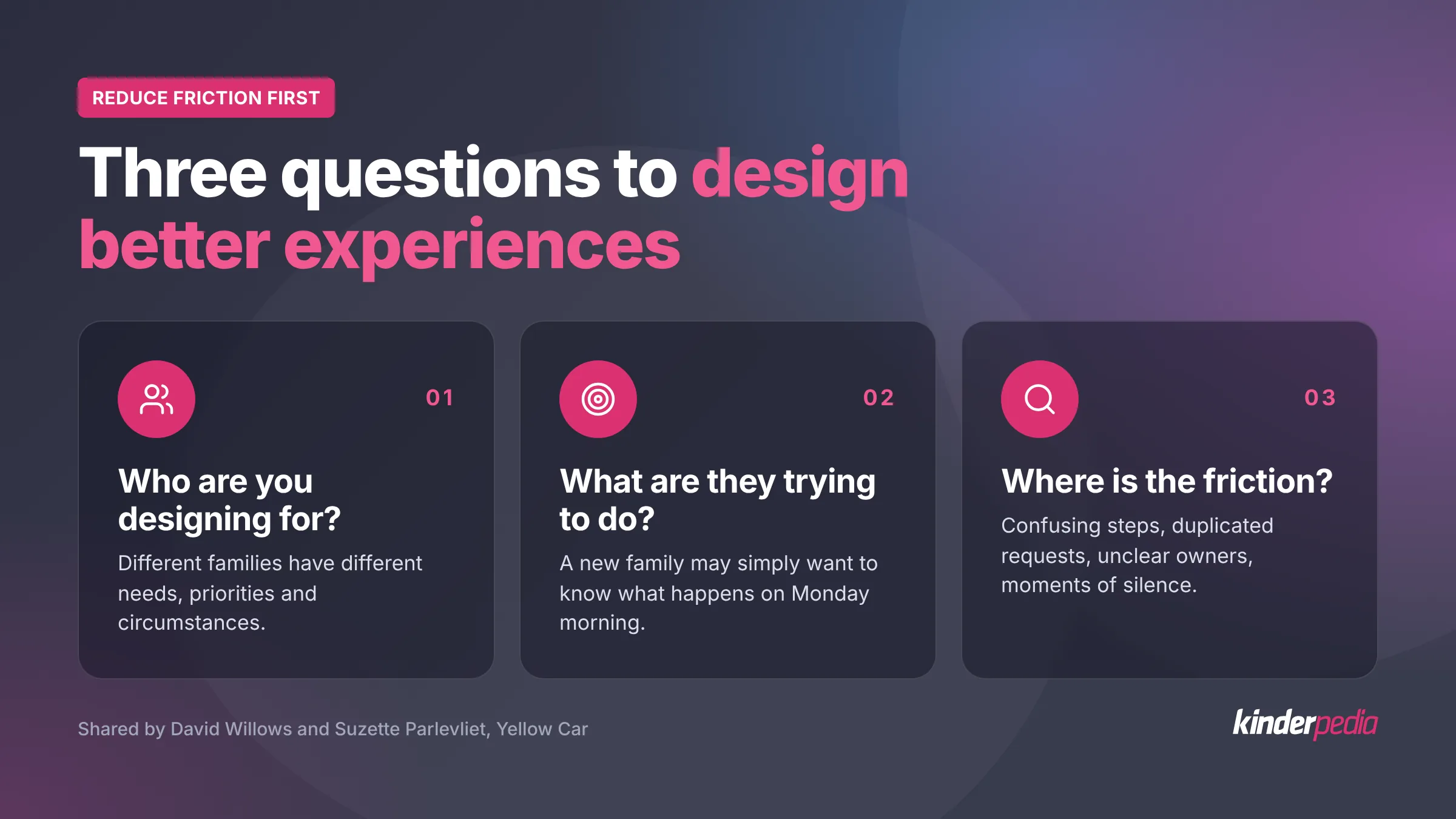
Who are you designing for? Different families have different expectations, priorities, and circumstances. Some need efficiency and quick answers. Others are looking for stronger social connections.
What are they trying to accomplish? A parent contacting admissions may need reassurance about their child's needs rather than a lengthy description of academic programmes. A new family may simply want to know what happens on Monday morning.
Where is the friction? Look for confusing instructions, duplicated requests, communication overload, unclear responsibilities, and moments when people feel ignored or uncertain.
Once schools identify these friction points, they can begin designing better experiences.
Sometimes the solution is a clearer email. Sometimes it's a new internal process, a more personal conversation, or a digital platform that connects information and people.
As Evelina pointed out, schools need to create an environment where memorable experiences can flourish without being undermined by everyday operational difficulties.
Technology works best when it makes the human side of education easier.
From good intentions to a consistent school experience
Every school has people who care deeply about students and families.
But a genuinely connected school experience cannot depend entirely on individual effort.
It needs shared expectations, clear responsibilities, and everyday habits.
During the webinar, Evelina offered several practical recommendations for schools looking to make communication more intentional.
Start by defining what successful communication should look like. Decide who is responsible for different types of updates, how frequently families should hear from the school, and which channels should be used.
Involve teachers and other members of the school community, not just the marketing or administrative team. Families value hearing directly from the people involved in their children's learning.
Most importantly, make communication part of the daily routine rather than an occasional activity.
And when something goes wrong, don't ignore it.
A misunderstanding or complaint can become an opportunity to listen, respond, and repair trust.
Consistency doesn't mean every interaction needs to be identical. It means families know what to expect and feel confident that the school will respond with clarity and care.
How to start improving your school's family journey
Improving the school experience doesn't require redesigning everything at once.
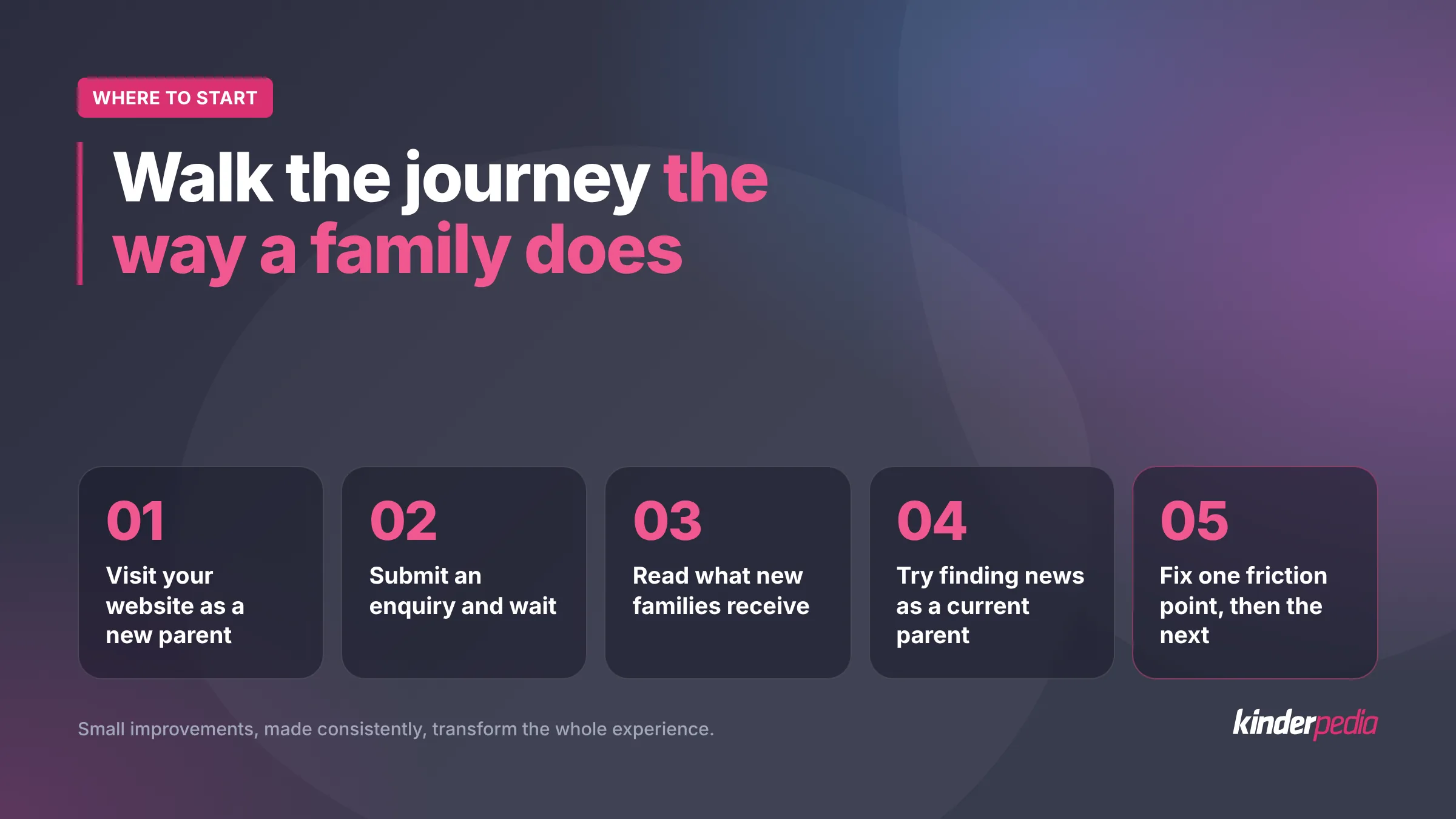
A useful first step is to walk through the journey from a family's perspective.
Visit your own website as if you were a prospective parent. Submit an enquiry. Review your admissions communication. Look at the information a new family receives before the first day.
Then explore the experience of a current parent.
Can they easily understand their child's progress? Find important announcements? Contact the right person? Participate in school activities?
Ask families and staff what works well and where they encounter unnecessary difficulties.
Choose one point of friction and improve it.
Then choose another.
During the webinar's Q&A, David and Suzette reminded participants that small improvements, made consistently, can gradually transform the overall experience.
The important thing is to begin.
A stronger school community starts with better everyday experiences
The family journey is not a series of disconnected administrative stages.
It's one continuous relationship, shaped by hundreds of interactions over many years.
The schools that build lasting trust are those that pay attention to the entire experience, from the first enquiry to the final farewell.
They help families feel informed rather than overwhelmed, involved rather than excluded, and valued rather than processed.
And they recognise that the most important part of education isn't simply the destination.
It's the childhood being experienced along the way.
At Kinderpedia, we believe that technology should support this human connection. By bringing school communication, classroom activities, student progress, and administration together in an all-in-one school management platform, we help schools create more clarity and make room for what matters most: meaningful relationships.
Frequently asked questions about the school family journey
What is the school family journey?
The school family journey is the complete experience a family has with a school, from the first online search or recommendation, through admissions, onboarding, and everyday school life, to graduation or departure. It includes every interaction that shapes how parents feel about the school and whether they trust it.
What are the six stages of the school family journey?
According to Yellow Car's Lifecycle of School Experience, the six stages are attraction, admissions, induction, engagement, retention, and departure and arrival. Looking at them as one continuous relationship helps schools avoid treating marketing, admissions, communication, and retention as separate silos.
How can schools improve parent engagement without overwhelming families?
Focus on clearer communication, not more communication. Agree on who sends which updates, how often, and through which channel, and bring messages, announcements, events, and progress information into one place. A parent who receives 36 emails a day feels overwhelmed, not informed.
How does the admissions process affect the family experience?
Admissions is often a family's first direct experience of how a school works. Prompt replies, clear next steps, and visits tailored to what matters to each family make parents feel heard rather than processed. An admissions CRM helps teams follow up consistently and carry family information forward into the student record.
Where should a school start improving its family journey?
Walk the journey the way a family does: visit your website as a new parent, submit an enquiry and wait, read what new families receive, and try finding news as a current parent. Then fix one friction point at a time. Small improvements, made consistently, transform the whole experience.
How can technology support the school family journey?
Technology works best when it removes everyday friction, so staff have more time for human connection. Platforms like Kinderpedia connect admissions, parent communication, progress monitoring, billing, and incident reporting, so families get clear, consistent information at every stage.
Watch the full webinar
Want to explore how to design a school experience that families remember?
Watch the full Kinderpedia webinar with David Willows, Suzette Parlevliet, and Evelina Necula, and discover practical ideas for building trust, belonging, and long-term growth in your school.


